Industries · Applications
US and Canadian Industrial Sectors and Their Crane Requirements
Nuclear, oil and gas, mining, pulp and paper, power generation and manufacturing across Canada each specify overhead cranes differently.

Arvanta Industrial
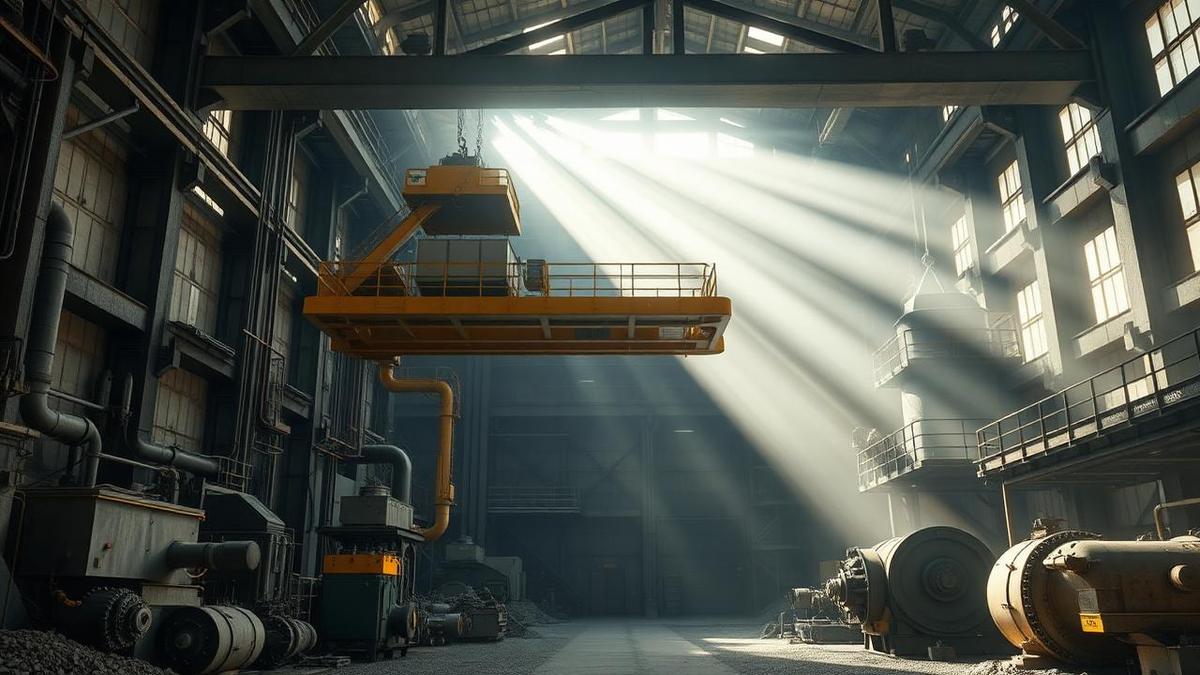
Canada does not have one crane market. It has several, and each industry buys differently. A hoist that is perfect for an Ontario manufacturing plant may be rejected in a Saskatchewan potash mine, a Texas refinery or a US steel mill. Understanding those differences is the difference between a product that sells and a product that sits.
Nuclear
Nuclear operators in Ontario, New Brunswick and the United States generate major lifting requirements through new construction, maintenance and refurbishment work. Buyers focus on documentation, traceability, single-failure-proof design where required, reliability during outage windows and rigorous quality programs. Reactor-building cranes, polar cranes, fuel-handling equipment and heavy maintenance cranes are highly engineered and long-cycle. Qualification is demanding and price is rarely the deciding factor.
Oil and Gas
Western Canada's upgraders, refineries, gas plants and oil-sands facilities, along with US facilities in Texas, Louisiana, Oklahoma and the Gulf Coast, need cranes that survive weather, hazardous-area classification and continuous maintenance duty. Common requirements include:
- Cold-weather packages for northern operations
- Hazardous-location electrical classification where applicable
- Maintenance and turnaround cranes sized for major equipment removal
- Corrosion protection for outdoor and process environments
Shutdowns are scheduled years ahead, and equipment that delays a turnaround is expensive in a way that dwarfs the crane itself.
Mining — Potash, Copper and Gold
Mining is a crane-intensive sector in both countries, and each commodity has its own conditions.
- Potash (Saskatchewan): highly corrosive environments require sealed components, protective coatings and corrosion-resistant hardware. Cranes serve mills, hoist houses, compactors and shaft equipment.
- Copper (British Columbia and the US Southwest): large concentrators use mill-maintenance cranes to handle grinding-mill liners, motors and crusher components at high capacity.
- Gold (Ontario, Quebec, Alaska and Nevada): remote sites make dust protection, ruggedness and serviceability critical. If a technician cannot get to site quickly, the design must tolerate long intervals between visits.
Across mining, duty class is high, dust ingress is constant and remote logistics dictate spare-parts strategy.
Pulp and Paper
Mills in British Columbia, Quebec, Ontario and the Atlantic provinces, as well as major US mill regions, operate in humid, warm and chemically aggressive environments. Typical needs include roll-handling cranes with C-hooks or vacuum lifters, recovery-boiler and digester maintenance cranes, and machine-hall cranes designed around precise positioning of paper reels. Downtime is measured in tonnes or tons of lost production per hour, so reliability and condition monitoring sell well in both markets.
Power Generation
Hydroelectric powerhouses across Quebec, British Columbia, Manitoba and the northeastern United States rely on high-capacity powerhouse cranes for generator rotor and stator lifts. Thermal and combined-cycle plants require turbine-hall cranes for rotor removal, while renewable and grid infrastructure adds transformer-handling requirements. These are engineered lifts across the 5 to 150+ ton range, where deflection limits, precise micro-speed control and tandem-lift capability are specified in detail.
Industrial Manufacturing
Automotive, aerospace, fabrication, food processing and general manufacturing form the broadest crane market in both countries by unit volume. Requirements are often lighter — across the 5 to 150+ ton range — with an emphasis on ergonomics, workstation cranes, radio controls, anti-sway, positioning systems and quick delivery. This sector buys through distributors far more often than through direct engineering procurement.
What this means for manufacturers
A single sales approach will not work across these sectors or across the US and Canadian territories. Heavy engineered cranes are sold through project development with owners, EPCs and consultants over long cycles. Hoists and components are sold through distributors and crane builders on availability, price position and spare-parts support. Technology and below-the-hook products often ride into a plant through the service company that maintains the equipment.
Arvanta builds the route to market around how your product is actually specified, purchased and supported in each US and Canadian industry.
Next step
Take the next step with Arvanta
Whether you manufacture equipment or sell and service it, we start with a short, confidential conversation about product fit, territory and market potential across Canada.
Related insights
Representation
What a Manufacturer's Representative Actually Does
A plain description of the commercial work between a factory abroad and a first order in Canada.
Market Entry
Canada First, Then the United States
Why a concentrated, reachable Canadian channel is a better first step than a broad U.S. launch.