Below-the-Hook · Applications
Below-the-Hook Lifting Devices: Choosing the Right Tool for the Load
A practical guide to below-the-hook lifting devices — beams, C-hooks, magnets, vacuum lifters, tongs, manipulators and more — and how to match the device to the load.

Arvanta Industrial
An overhead crane is only part of a lifting system.
The equipment positioned between the crane hook and the load can be just as important as the crane itself.
Known collectively as below-the-hook lifting devices, these products allow cranes and hoists to safely lift, position, rotate, grip, spread, or manipulate loads that may otherwise be difficult to handle with conventional slings.
Choosing the right device can improve productivity, reduce handling time, protect the product, and improve operator safety.
At Arvanta Industrial, we believe lifting equipment should be selected around the application and the load. Understanding the different types of below-the-hook devices is an important part of that process.
Lifting Beams
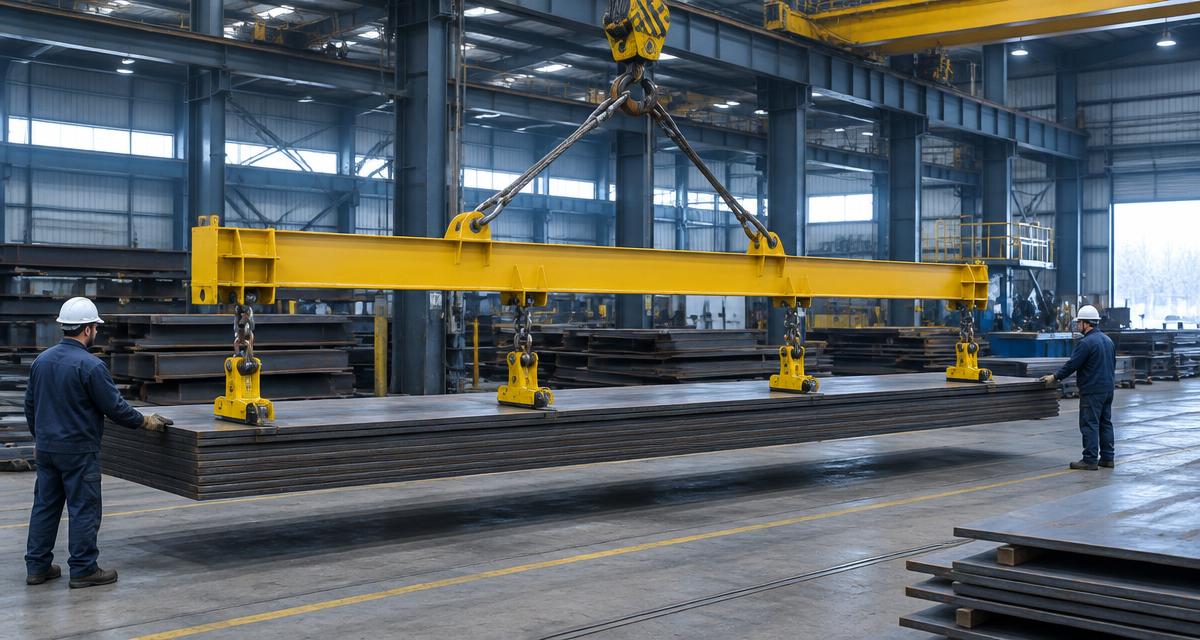
A lifting beam is one of the most common below-the-hook devices.
The crane typically connects to a central lifting point on the beam, while two or more lower attachment points connect to the load.
Lifting beams are useful for distributing lifting forces across multiple points and can help control long or awkward loads.
Common applications include:
- Structural steel
- Machinery
- Fabricated assemblies
- Long components
- Industrial equipment
- Precast products
Lifting beams are particularly useful when a load requires multiple lifting points but available headroom is limited.
Spreader Beams
Spreader beams perform a similar function but operate differently.
Instead of primarily bending like a lifting beam, a spreader beam is generally loaded in compression between two lifting slings connected to the crane hook.
This design can make spreader beams suitable for larger capacities or longer spans.
Typical applications include:
- Large fabricated structures
- Pressure vessels
- Long equipment
- Heavy machinery
- Modular assemblies
- Construction components
Spreader beams are also valuable when sling angles need to be controlled to reduce inward forces on a load.
Coil Lifters and C-Hooks
Steel coils and other rolled materials create unique lifting challenges.
A C-hook is designed to enter the centre opening of a horizontal coil so the crane can lift the coil from the inside diameter.
These devices are widely used in:
- Steel mills
- Steel service centres
- Metal processing facilities
- Automotive manufacturing
- Coil storage operations
C-hooks can be designed for specific coil widths, diameters, and capacities.
Protective surfaces or padding may also be incorporated to minimize damage to the coil.
Sheet Lifters and Plate Clamps
Steel plate and sheet material can be difficult to handle safely with conventional slings.
Plate clamps mechanically grip the material and are commonly used for lifting individual plates vertically or horizontally depending on the device design.
Larger sheet lifters may use multiple gripping points or specialized mechanisms to handle large plate packages or fabricated sheets.
Applications include:
- Steel fabrication
- Shipbuilding
- Structural steel manufacturing
- Machine shops
- Steel distribution centres
It is important that clamps are selected specifically for the orientation, thickness, hardness, and weight of the material being lifted.
Lifting Magnets
Industrial lifting magnets provide a fast method of handling ferrous materials without attaching slings or mechanical clamps.
Depending on the application, systems may use:
- Permanent magnets
- Electromagnets
- Electro-permanent magnets
Magnets are commonly used for:
- Steel plate
- Structural steel
- Billets
- Beams
- Pipe
- Scrap metal
- Machined components
- Steel fabrication
One major advantage is speed.
An operator may be able to engage a magnetic lifting device without manually attaching slings to the load, which can significantly reduce handling time.
However, magnet selection must consider material thickness, surface condition, air gaps, shape, temperature, and the type of steel being handled.
Vacuum Lifters
Vacuum lifting equipment is commonly used where traditional hooks, slings, or clamps could damage the product.
Vacuum systems create suction between lifting pads and the surface of the load.
Typical applications include:
- Sheet metal
- Glass
- Wood panels
- Plastic sheets
- Stone
- Composite panels
- Large fabricated panels
Vacuum lifters can also allow operators to tilt or rotate loads during production.
For repetitive handling applications, this can substantially improve ergonomics.
Pallet Lifters
Pallet lifters allow an overhead crane to transport palletized material without requiring a forklift.
The device typically incorporates forks or a supporting frame that engages beneath the pallet.
Common applications include:
- Warehouses
- Construction sites
- Manufacturing facilities
- Production areas
- Material staging operations
Some designs incorporate automatic balancing systems to compensate for different pallet loads.
Drum Lifters
Industrial drums and barrels often require specialized lifting attachments.
Drum lifters can grip the rim, sides, or body of a drum depending on the application.
Certain designs can also rotate or tilt the drum for controlled pouring.
These systems are commonly used in:
- Chemical processing
- Food production
- Manufacturing
- Waste handling
- Industrial maintenance
Pipe and Round-Product Lifters
Pipe, tubing, rolls, and cylindrical components are especially prone to rolling or shifting during lifting.
Specialized pipe lifters, grabs, tongs, and lifting beams can provide secure handling for these products.
Applications may include:
- Pipe manufacturing
- Oil and gas facilities
- Steel mills
- Fabrication shops
- Distribution centres
The lifting device can be designed around the diameter, length, weight, and surface characteristics of the product.
Tongs and Mechanical Grabs
Mechanical lifting tongs use the weight of the load to create gripping force.
They can be designed for products including:
- Ingots
- Slabs
- Blocks
- Concrete products
- Pipe
- Rolls
- Timber
- Structural components
These systems can be particularly useful in high-cycle industrial environments where repeatedly attaching slings would reduce productivity.
Rotators and Load Positioners
Sometimes the challenge is not simply lifting a component—it is positioning it.
Load rotators and positioners allow components to be turned, tilted, or rotated while suspended from the crane.
This can significantly improve accessibility during:
- Welding
- Assembly
- Inspection
- Machining
- Maintenance
- Manufacturing
Instead of workers manually repositioning heavy components, the lifting system performs the movement.
Fork Lifters and Specialized Lifting Frames
Many industrial loads require custom lifting geometry.
Engineered lifting frames can be designed specifically around equipment, machinery, production components, or manufactured products.
Examples can include:
- Engine lifting frames
- Transformer lifting beams
- Battery lifting devices
- Mold handling systems
- Die handling equipment
- Machinery lifting frames
- Custom production fixtures
In these situations, an engineered below-the-hook device may provide a much safer and more repeatable lifting method than conventional rigging.
Manipulators and Intelligent Lifting Devices
For high-frequency production environments, lifting equipment can go beyond traditional hooks and slings.
Industrial manipulators and intelligent lifting devices can allow operators to lift and position loads using very little physical force.
These systems may incorporate:
- Pneumatic lifting
- Servo-controlled lifting
- Vacuum gripping
- Mechanical gripping
- Magnetic gripping
- Powered rotation
- Custom tooling
Applications can include assembly lines, automotive manufacturing, packaging, fabrication, and repetitive production.
The Right Device Can Transform a Lifting Process
A crane provides the movement.
The below-the-hook device determines how the crane interacts with the product.
Selecting the correct lifting attachment can reduce rigging time, improve load control, protect products, improve ergonomics, and significantly increase productivity.
The important questions are not simply:
How heavy is the load?
Facilities should also consider:
- What shape is the load?
- Where is its centre of gravity?
- How often is it lifted?
- How will the operator attach to it?
- Does the load need to rotate?
- Can the surface be damaged?
- Is worker access to the load difficult?
- How much headroom is available?
- Can the lifting process be automated?
At Arvanta Industrial, we help industrial facilities evaluate the complete lifting application—from the crane and hoist to the equipment actually connecting with the product.
Because sometimes the biggest improvement to a material-handling process isn't changing the crane.
It's changing what hangs underneath it.
Next step
Take the next step with Arvanta
Whether you manufacture equipment or sell and service it, we start with a short, confidential conversation about product fit, territory and market potential across Canada.
Related insights
Applications
Workstation Cranes and Jib Cranes: Versatile Material Handling Solutions for the Modern Workplace
How workstation cranes and jib cranes work together to create efficient, ergonomic lifting zones for production, assembly and machining.
Representation
What a Manufacturer's Representative Actually Does
A plain description of the commercial work between a factory abroad and a first order in Canada.